

Who We Are
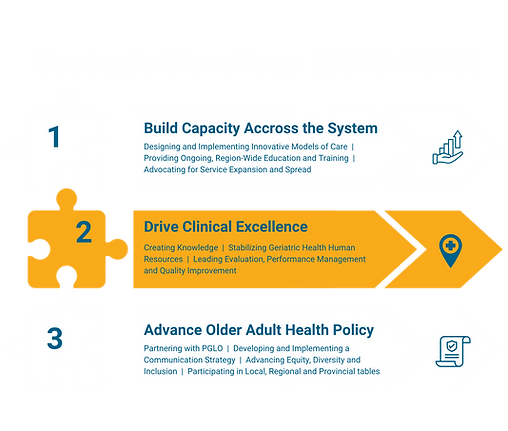
Seniors Care Network is responsible for the organization, coordination and governance of specialized geriatric services (SGS) in the Central East Region of Ontario Health East.
Key services include the planning, design, implementation, evaluation, quality improvement, and performance monitoring of SGS. Applied health research is a key component of Seniors Care Network’s mandate. Additionally, subject matter expertise is provided to partner organizations including Ontario Health Teams.

%20(24%20x%2018%20in).png)


What's New
Conference presentations
Over the next few months, we will continue to share our latest work and insights at several provincial and national conferences, including AFHTO's Power of Primary Care Summit, the Canadian Association on Gerontology (CAG) Conference, and the Age-Well Annual Conference. We’ll be presenting on key topics related to our recent projects and findings. Check our schedule, connect with our team, and access related resources on our website.
📢 Frailty Webinar Recording & Resources Now Live!
💡By watching this session, you will be able to:
Understand how proactive frailty screening and management can strengthen care for older adults and support upstream Alternate Level of Care (ALC) avoidance strategies.
Explore the key components of the Seniors Care Network Frailty Pathways and identify concrete opportunities to weave them into your existing practices.
Walk away with valuable, real-world lessons and promising practices shared by early adopters who are already seeing success.
Central East Cognition Referral Pathway Guidance Document
This Guidance Document is an evidence-informed resource designed to support the early identification of cognitive concerns and timely access to appropriate services for older adults. Intended for primary care providers and Specialized Geriatric Services (SGS), it provides a structured approach to screening and referral decision-making by incorporating both cognitive and frailty considerations.
The focus of the Pathway is not on directing clinical management. Rather, it supports consistent referral practices, service navigation, and transitions across the continuum. Tested through a regional pilot evaluation, the approach demonstrated potential for alignment between patient needs and SGS connections. Thereby, helping to promote more person-centred care for older adults and their care partners.
GEM Patient
“The GEM nurse listened to me and made me feel safe when I was scared. Thank you for taking the time to see [me] as a whole person.”
GAIN Patient
“The GAIN team was never afraid to get involved. Everyone else kept me at arms length. GAIN wasn’t afraid of anything, they just got involved and helped me.Whenever I needed them, they were there.”
Family member of a Memory Clinic client
“I never knew medications could have this much impact. I have my mother back now. Thank you for everything.”